
Danish-Canadian History
From the first settlement in New Denmark in 1872 to the founding of our Federation in 1981, discover the rich heritage of Danes in Canada.
Danish Immigration to Canada
According to census data, there are about 170,000 people of Danish origin in Canada, found in all walks of life across all provinces and territories.
There have been three major waves of Danish immigration: from the late 1880s to 1914, during the 1920s, and in the 1950s–1960s. The peak year was 1957, when 7,790 Danes immigrated to Canada—more than any other year.
Late 1880s – 1914
First major wave of Danish immigration
1920s
Second wave, many settlements founded
1950s – 1960s
Post-WWII immigration boom
1957
Peak year: 7,790 Danish immigrants
Danish Settlements across Canada
The Journey to Canada
In the 1920s, Danish immigrants came to Canada by ship. They could board the SS Frederik VIII, the SS Hellig Olav, the SS Oscar II, or the SS United States in Copenhagen and sail directly to Halifax. These ships were operated by the Scandinavian America Line, owned by DFDS of Copenhagen.
After the Second World War, Danish immigrants could sail from Scandinavia with the Swedish American Line or the Norwegian America Line, which both called at Halifax. Another possibility was the Polish liner MS Batory, which sailed to Montreal—and Halifax in winter.
The Danes who came by ship can tell both wonderful and terrifying stories about the voyage—storms, hurricanes, and seasickness, as well as bountiful food, great parties, and live entertainment on board. For all of them, it was the experience of a lifetime.
Many also remember their arrival at Pier 21 in Halifax, being processed through Immigration and then boarding trains for Montreal, Toronto, Winnipeg, and points further West. Between 1928 and 1971, 47,295 Danes entered Canada through Pier 21.
Our Big Year of Immigration
by Rolf Buschardt Christensen
More Danes immigrated to Canada in 1957 than in any other year. According to government statistics, 7,790 immigrants came from Denmark that year—compared with 4,621 in 1951 and between 3,000–4,000 in 1928, 1929, and 1956.
In 1949, Canada opened its doors to immigration from Denmark with few hindrances. At the same time, Danes were also immigrating to the United States and Australia. Some Danish immigrants came to Canada for adventure or to try something new. A fair number who came in the 1950s did return to Denmark—but some actually came back to Canada again!
Several factors pushed emigration from Denmark in 1957: the Danish economy hadn't fully recovered from the War until 1957–58; there was a severe housing shortage; persistent unemployment; and in March–April 1956, major strikes and lock-outs occurred. The Suez Crisis in fall 1956 led to oil and gas rationing in Denmark. The Hungarian Uprising brought the brutality of the Soviet Union into Danish homes through newly acquired TV sets—with the Nazi Occupation still fresh in memory, many Danes felt a safer future lay across the ocean.
The Danes were economic immigrants—on their own but prepared to work. They wanted to get ahead and contribute. For the Danes, there have been many accomplishments, but also hardships. In general, however, they have done well, made their old country proud, and succeeded in realizing their grandest pursuits and wildest dreams.
Danish Settlements in Canada
Danish settlers established communities from coast to coast, building churches, schools, and thriving agricultural enterprises.
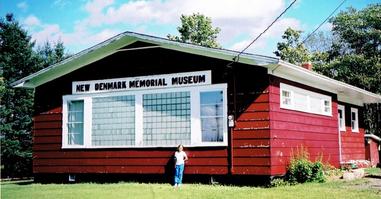
New Denmark, New Brunswick
The oldest Danish settlement in Canada. Captain Søren Severin Heller recruited twenty-seven people to settle in New Brunswick, arriving June 19th, 1872. An agricultural area well-known for its potatoes.
★ Oldest Danish Settlement in CanadaPottersburg (London), Ontario
About forty butchers and sausage makers settled here, attracted by a large pork packing plant built by John Ginge.
Cape Scott, British Columbia
Danish immigrant Rasmus Hansen established a settlement at the northwestern tip of Vancouver Island. Despite hardships and a promised road that never materialized, the settlement persisted until 1917. Now a provincial park.
Dickson, Alberta
The oldest Danish community in the Canadian Prairies. Seventeen Danes from Nebraska claimed homestead land. The Dickson Store, which operated until 1980, is now a museum.
Standard, Alberta
Originally called 'Danaview' by Danes from Iowa, renamed 'Standard' after the Royal Danish Flag. The railway arrived in 1911.
Dalum, Alberta
Sponsored by 'Dansk Folkesamfund' and named after an Agricultural School in Denmark. The Bethlehem Lutheran Church was completed in 1936.
Pass Lake, Ontario
Danish settlers cleared land 60 km east of Thunder Bay. By the 1930s, Pass Lake became famous for its strawberry crops—over 20 acres yielding 70,000 quarts in 1935.
Ostenfeld, Manitoba
Founded by Danish Immigration Pastor Niels Damskov from Winnipeg, named after Bishop Henrik Ostenfeld who visited Winnipeg in 1923.
Other Danish settlements were founded in the 1920s at Wallace, Nova Scotia; Redvers and Alida, Saskatchewan; and Tilley and Kevisville, Alberta.

St. Ansgar's Anglican Church
The Churches of New Denmark
Upon entering New Denmark, you'll find two churches standing opposite each other: St. Ansgar's Anglican Church and St. Peter's Lutheran Church.
Niels Hansen, a Lutheran lay missionary, arrived in New Denmark in 1875. When life proved difficult, a visiting Anglican clergyman suggested Hansen become a minister of the Church of England. St. Ansgar's was consecrated in 1884, though the congregation maintained its Danish character—standing to pray, sitting to sing, and retaining the Lutheran catechism in Sunday school.
St. Peter's Lutheran Church was built in 1905. The church minutes continued to be written in Danish until 1960, and Danish services continued until around 1969. A Danish hymn is still sung every Sunday.
Founding of the Federation
June 7, 1981 • Sunset Villa, Puslinch, Ontario
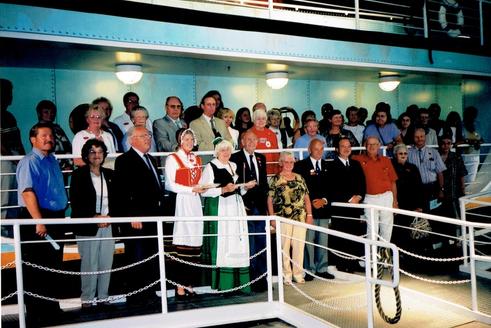
Rolf Christensen pointing to where the 1981 founders' photo was taken
Thirteen people representing Danish organizations from Montreal to Vancouver gathered at Sunset Villa to establish the Federation of Danish Associations in Canada.
The Federation was established with the purpose of bringing together all existing Danish organizations in Canada, to create a permanent network of cooperation. It is a "Club of Clubs"—the national umbrella organization of the Danes in Canada.
The Federation was formed to strengthen personal and institutional contacts, to exchange ideas and experiences, and to cooperate on joint projects that could not be handled by one organization alone.
The first national Conference was held in Vancouver in May 1982, less than 12 months after founding. By then, the Federation had grown to 17 member organizations. Today, we have over 40 member organizations.
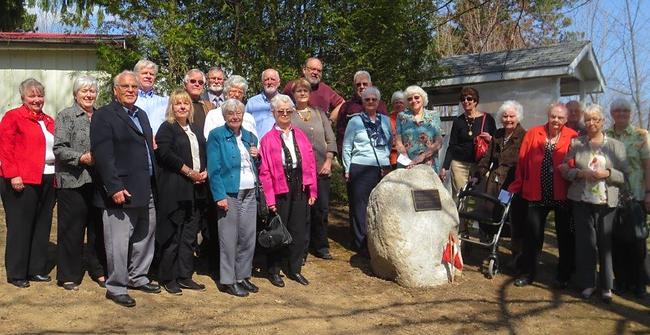
Commemorative Plaque at Sunset Villa
April 27, 2013
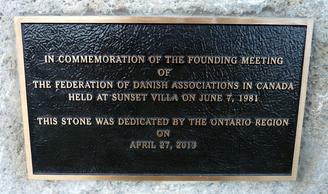
On April 27, 2013, a plaque commemorating the founding of the Danish Federation was unveiled at Sunset Villa in Puslinch, Ontario. The initiative came from the executive of the Ontario Region.
The stone was generously donated by the CBM gravel pit close to Sunset Mindepark. It is grey granite, millions of years old, brought down from Canada's north in the last ice age and deposited in the Puslinch area when the glacier melted.
The stone now sits in front of Sunset Villa as part of a half-circle of commemorative stones, reminiscent of the old Nordic "Ting" assemblies during the Viking period and Middle Ages, which democratically exercised judiciary and legislative power.
Ontario Region leaders at the 2013 plaque unveiling ceremony
The Danish Plaque at Pier 21, Halifax
Pier 21 Danish Plaque
August 30, 2002
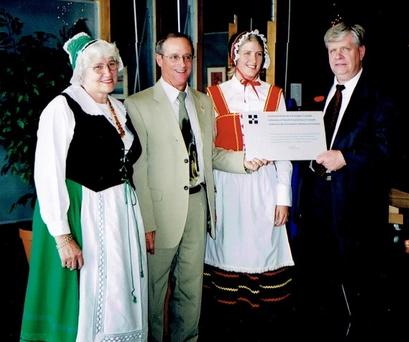
A Danish Plaque was unveiled at Pier 21 in Halifax—the former immigration shed through which 1.25 million immigrants entered Canada between 1928 and 1971, including 47,295 Danes.
Johanne Knudsen of Toronto presented to Pier 21 the suitcase she carried when she landed there in 1957, along with her old passport and other documents.
"From Denmark we came with hopes and dreams, but also with tools in hand. To build a new life, pursuing those dreams, in this, our chosen land. And Canada opened her arms to us all, with her cities, forests and farms. All people together, working as one. Canadians—linking arms."
— Edith Wulff
Canadian Lung Association Monument
August 23, 2003 • Saint John, New Brunswick
The Canadian Lung Association unveiled a monument in Rockwood Park to commemorate its centennial, honouring Einar Holbøll—the Danish postmaster who created the Christmas Seal in 1903 to raise money to fight tuberculosis.
The stone for the monument, weighing over four metric tonnes, was excavated southwest of Holbæk, Denmark, and donated by the Federation. Pastor Poul Berg Sundgaard found the suitable stone at a quarry belonging to Colas Danmark A/S, who donated it when they learned its purpose.
The monument, prominently situated on the main park road, mentions Einar Holbøll, the stone from Denmark, and the Danish Federation. It is flanked by Canadian and Danish flags.
Pastor Poul Berg Sundgaard at the Monument
Danish Lutheran Churches in Canada
Danish Lutheran Churches have long served as the spiritual and cultural heartbeat of Danish communities across Canada, providing a cherished gathering place where language, faith, and tradition were faithfully preserved through generations. From the prairies of Alberta to the cities of Toronto and Vancouver, these congregations have been steadfast pillars of the Danish-Canadian identity, nurturing the bonds that the Federation holds dear.
Their enduring presence stands as a testament to the dedication of Danish immigrants who built lasting institutions for their families and communities — a legacy the Federation of Danish Associations in Canada continues to honour and celebrate.
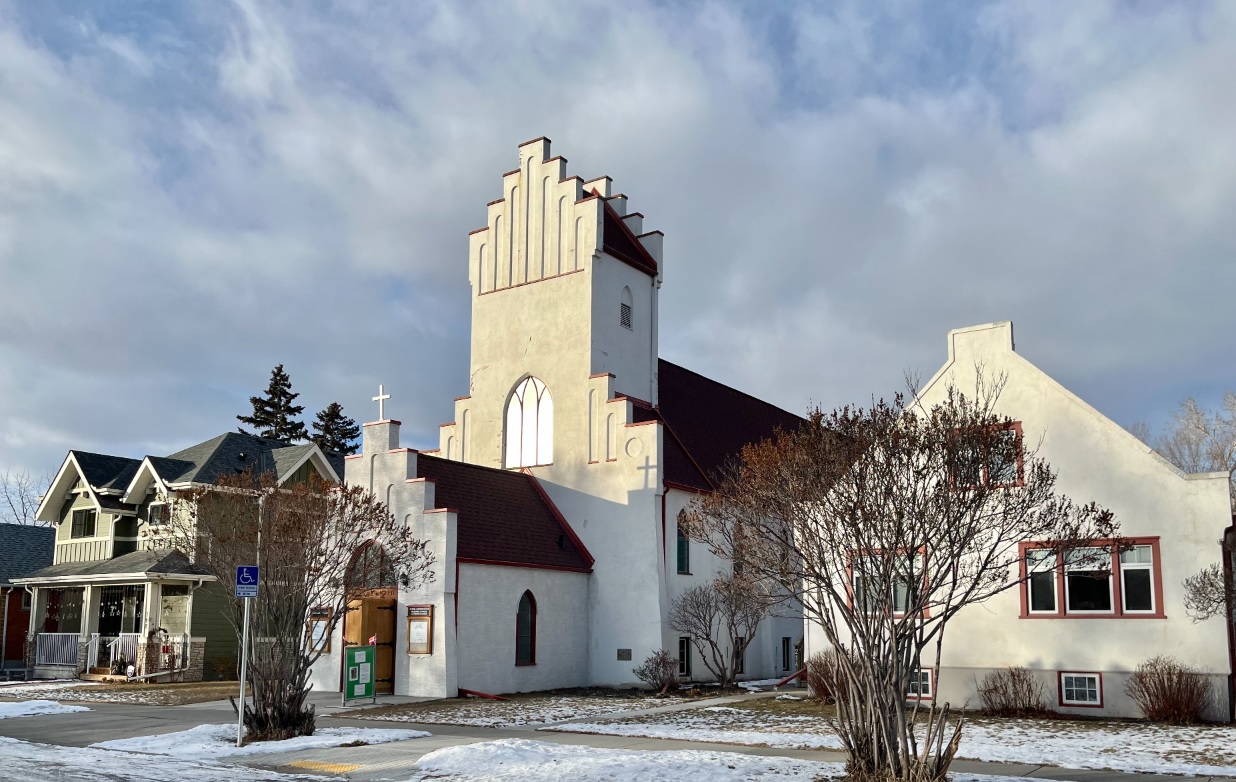
Sharon Danish Lutheran Church, Calgary
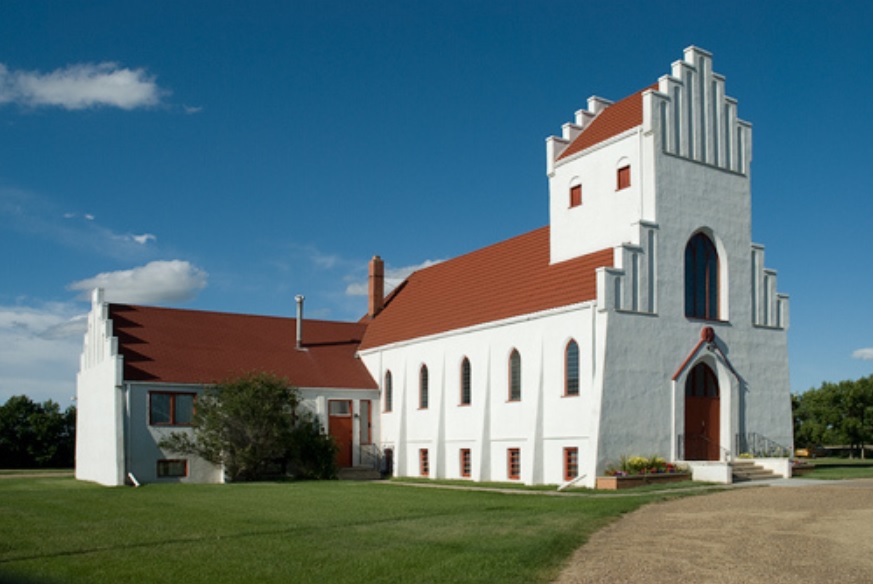
Bethlehem Lutheran Church, Dalum, Alberta
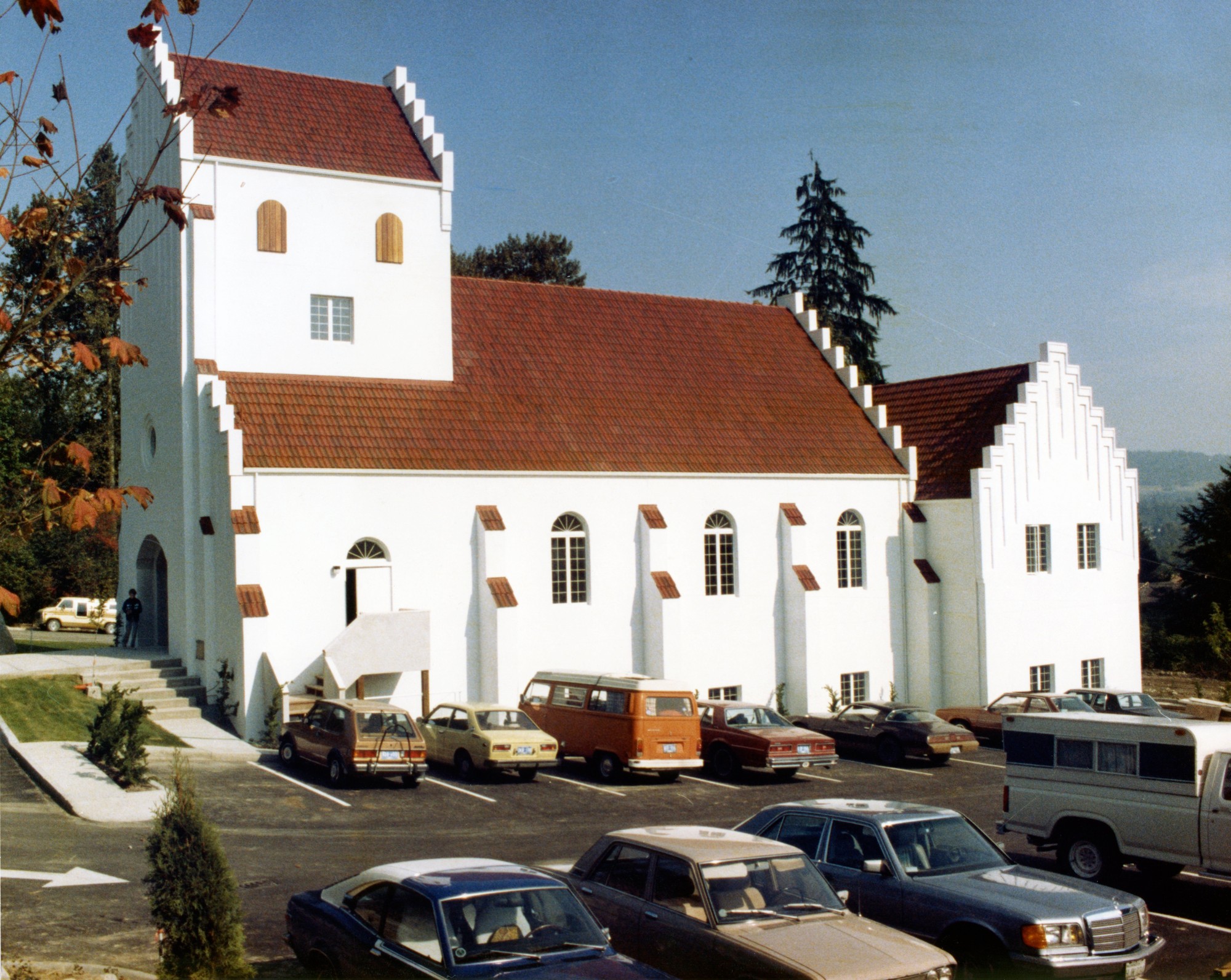
Danish Lutheran Church, Vancouver
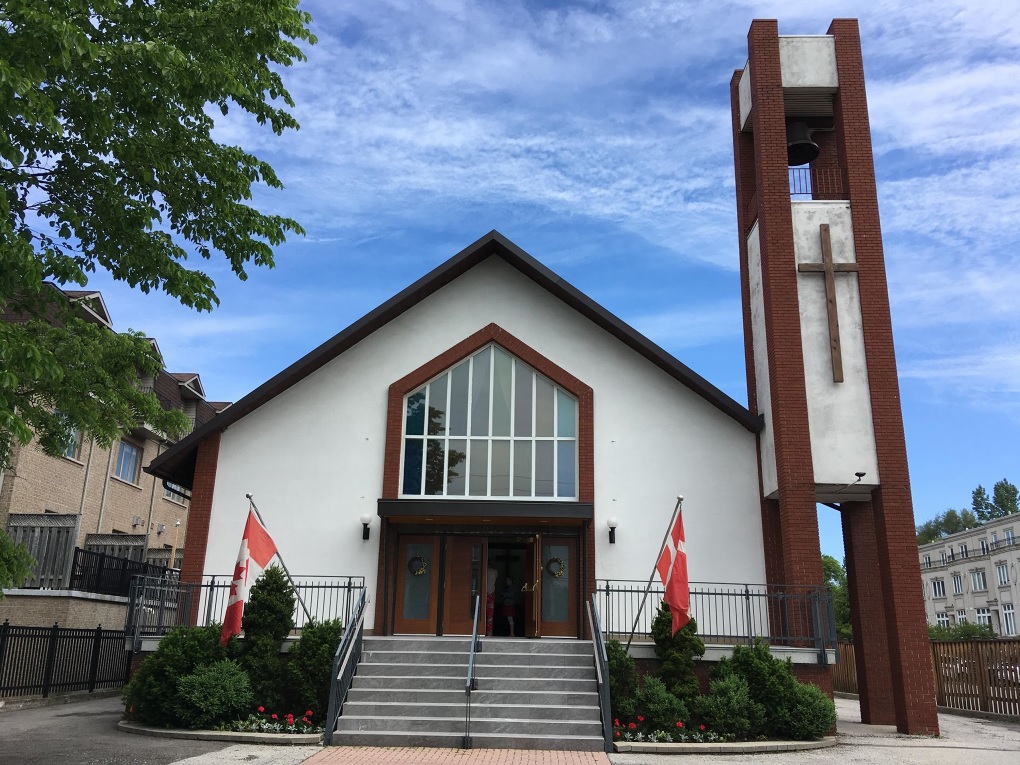
Danish Lutheran Church & Cultural Centre, Toronto
Danish Contributions to Canada
The Danes have formed social clubs, built churches, and published newspapers. They have made significant contributions to Canada in many fields.
Dairy Industry
Cooperative Movement
Gymnastics
Senior Homes
Danes were among the first to build homes for senior citizens in Canada.
Explore Our Heritage
Learn more about the Federation's mission and the organizations that continue preserving Danish heritage across Canada today.